






Educational institutions face unique and distinct digital challenges in 2026. With access to an increasingly diverse and international audience, it is more important than ever to present an appealing and engaging brand online.
Here’s Kooba’s guide to doing exactly that, based on our award-winning experience in the industry:
Making the complex simple
The most immediate challenge faced by educational institutions is the sheer scale of information and data that needs to be hosted within their sites. Hundreds of different courses, often spread across multiple campuses, and available in any number of permutations and combinations. It’s an organisational nightmare, but requires an elegant solution to allow potential students to quickly understand what options are (and aren’t) available.
To address this, a UX design team must create a logical and comprehensive model of your website, and carefully construct the information architecture of the site to match the underlying organisation of your courses. For each institution, this will look different, and the design solutions will vary in each case.
As a general rule, the end experience for each prospective student should be simplified to the greatest extent possible. This means that they can find the information they need with a minimal number of clicks, avoiding frustration and lost conversions.
Perfecting your position
Another key issue for third-level universities is that of positioning. Within local markets, students may be aware of your relative qualities and advantages against competitors, but for international students, these distinctions are less clear. Unless your website can effectively communicate the strengths of your brand, you’ll struggle to attract the same volume and caliber of students.
To accomplish this, you’ll need to pay attention to the visual presentation of your website, and focus clearly on the exact impression you’d like to convey to prospective students. From a design perspective, Kooba can help you by identifying examples from across the industry, building moodboards to help define your aesthetic, and bringing your site to life with motion and interaction design.
Done right, this not only creates a more beautiful website, but also a more effective one. Students and staff will be more likely to engage with your organisation, and you’ll be able to price yourself appropriately compared to your regional competitors. This means real gains for your organisation across the enrolment and conversion metrics that matter the most to your team.
A new acquisition channel: AI visibility
Finally, the ways that users find and learn about your organisation are changing. Rather than relying on brochures, directories and Google searches, students are now using LLMs such as ChatGPT and Claude to research and select the courses and institutions they will attend.
There are many ways to improve the AI visibility of your website, particularly by ensuring that each piece of content is correctly labelled and described within your code. This process also benefits from a more logical website layout, as more logically organised sites will be more attractive to AI tools.
To learn more about the possibilities of AI visibility, you can see our recent blog on the subject here.
Case study: South East Technical University
To see all this in action, take the example of our work for South East Technical University. On this website, Kooba needed to amalgamate two separate university sites into one unified platform, complete with best-in-class usability, accessibility, and visual design.
The result is a solution that makes interaction easier for prospective and current students alike, and empowers SETU in their marketing campaigns and brand promotion. Reflecting the exceptional quality of this website, Kooba were awarded the “Best in Universal Design” Spider Award for their work on the SETU website in 2024.
You can see our full case study on SETU here, or visit the SETU website itself here.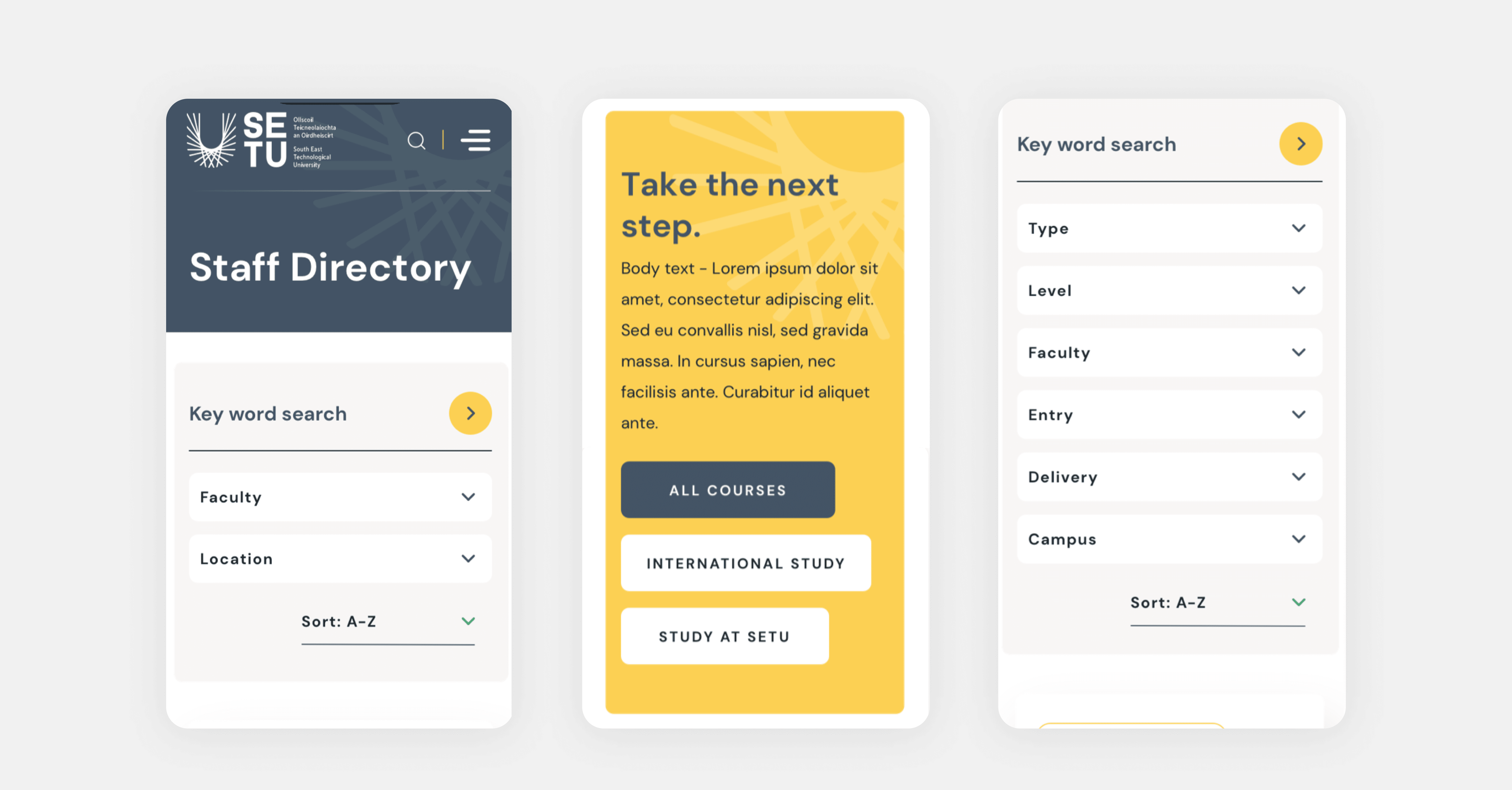
To start improving your own website today, just get in touch with our team at Kooba, we’d love to hear from you!